

Procedures
Blepharospasm - Overview & Treatment
- Blepharopspasm was first described in the 16th century by the painting by Pieter Brueghel entitled "De Gaper."
- During the 16th century, patients were institutionalized in insane asylums
- Little progress was made in understanding and treating blepharospasm until the mid-1900's.
- In 1907, Meige described a similar patient with dystonia which is now termed Meige syndrome.
- In 1956, Henderson wrote a classic article on Blepharopspasm describing the disability and treatments.
- can occur with specific precipitating stressors, such as bright lights, fatigue, and emotional tension; as the course continues, it occurs more frequently during the day and it may intensify so that when the spasms occur the eyelids may remain forcefully closed for short periods of time. Of note, the spasms disappear sleep and often by concentrating on a specific task.
- Possible origins include: basal ganglia, psychosomatic
- Early manifestations include frequent blinking which proceeds to involuntary spasms of the orbicularis
Loading the player ...
Definitions
- Isolated Blepharopspasm (spasm limited to the eyelids) is present only in a minority of "blepharospasm" patients
- The remainder of patients have associated lower facial spasms.
- Many prefer the following rubric to describe the syndrome:
- Blepharospasm: spasm only of the eyelids
- Meige syndrome: spasm in the eyelids and midface
- Brueghel's syndrome: spasms in eyelids associated with marked spasms in the lower face and neck
- Segmental cranial dystonia: eyelid and facial spasms associated with spasms in the cranial nerve distributions in addition to the seventh nerve
- Generalized dystonia: eyelid and facial spasms associated with spasms in additional parts of the body
Incidence
- affects approximately 300 out of every one million people
- average age: 45-70
- more common in women
Differential diagnosis
-
Hemifacial spasm
- unilateral
- spasm or contractures occur while awake or asleep
- due to vascular compression of facial nerve at the brain stem
- work-up must rule-out tumor at cerebellar pontine angle
- treatment is via neurosurgery
Treatments
- Medical Therapy
- Anticholinergics have been the most common and effective drugs with GABA-ergic drugs as the second most effective group
- In the early 1980's, Scott described botulinum-A toxin treatment for strabismus and soon after began using it in blepharospasm.
- It was approved in 1989 by the FDA and replaced a full myectomy procedure as the treatment of choice.
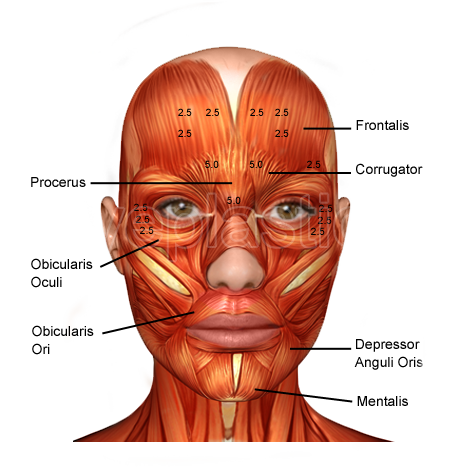
- botulinum injections (lasts 12-16 weeks) (see below)
|
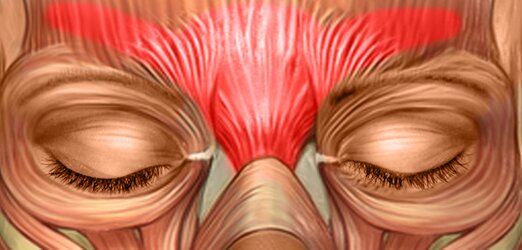
In 1970's, Dr. Rick Anderson described a procedure called "full myectomy" in which the surgeon meticulously excises virtually all of the orbicularis muscle as well as the corrugator superciliaris and procerus muscles. These results were published in 1981.
Excision of ocular protractors (Anderson procedure)
|
|
- Selective ablation of facial nerve, temporal and zygomatic branches
- Education and support
- Wearing tinted glasses with UV block to decrease the light sensitivity is also recommended.
- Lid hygiene to decrease blepharitis and irritation to relieve the irritation from dryness is also useful.
- Correction of Ptosis
Etiologic Findings
- A specific cause for Blepharopspasmas well as its central control center remain unidentified.
- Blepharopspasm is multifactorial in origin and in manifestation
- It is doubtful that a specific locus causes blepharospasm
What is botulinum toxin A?
- It is a toxin produced by the bacteria Clostridium botulinum which weakens muscles by blocking nerve impulses transmitted from the nerve endings of the muscles.
-
Is botulinum toxin A safe?
- Botulinum toxin is an approved treatment for Blepharopspasm and hemifacial spasm.
- Long-term follow-up studies have shown it to be a very safe and effective treatment, with up to 90 percent of patients obtaining almost complete relief of their Blepharopspasm .
- Side effects include Ptosis, blurred vision, and double vision (diplopia), Lagophthalmos, ectropion, sagging of the mouth, brow droop, epiphora.
-
How is botulinum toxin A used
- It is used to treat Blepharopspasm (Blepharospam refers eyelid muscles around the eye which close involuntarily. This may cause loss of vision, especially while reading, headaches, and eyebrow strain. The early symptoms of blepharospasm include increased blink rate (77%), eyelid spasms (66%), eye irritation (55%), midfacial or lower facial spasm (59%), brow spasm (24%), and eyelid tic (22%) with injection of tiny doses of botulinum toxin several sites above and below the eyes.
- The sites of the injection will vary slightly from patient to patient and according to physician preference.
- The injection is usually given on the eyelid, the brow, and the muscles under the lower lid. The injections are carried out with a very fine needle
-
How long does it take to work?
- Benefits begin in 1 - 14 days after the treatment and last for an average of three to four months.
Ptosis: Ptosis is also known as Blepharoptosis. It refers to an eyelid which is droopy. This may cause a loss of vision, especially while reading, headaches, and eyebrow strain.
Lagophthalmos: Patients with lagophthalmos have an inability to close eyelids. This may occur, for instance, in patients with Thyroid eye disease. Visit the lagophthalmos page for more details.
Ectropion: Ectropion is when the eyelid turns out. Visit the Lid Malposition page for more details.
Epiphora: Patients with epiphora complain of watery eyes; it is when there is an imabance between production and drainage of tears. Visit the LACRIMAL page for more details.

Learn about Xeomin Botulinum


