

Procedures
Lacrimal System - Overview
Overview, Signs and Symptoms of an Obstruction
-
The lacrimal gland produces tears which enter into the "duct"
that drain the tears from the eye into the nose. The most common symptoms are- (1) excess tearing (tears may run down the face) and
- (2) mucous discharge
- If one has a plugged up "tear duct," not only will tears spill over the eyelids and
run down the face, but the stagnant tears within the system can become infected. - This may lead to recurrent red eyes and infections.
- The excessive tearing can also produce secondary skin changes on the lower eyelids.
Congenital Nasolacrimal Duct Obstruction
Nasolacrimal Duct Obstruction (NLDO) is very common in infants.
- Children are frequently born with an obstruction within the "tear duct." In fact, 6% of all children are born before their tear ducts are open.
- The stagnant tears within the "tear duct" often become infected causing pus (heavy matter) to collect between the eyelids.
- Antibiotics may help some of the symptoms, BUT this is not cure for the blockage
- Such obstructions may resolve spontaneously within the first few months of life. In fact, 95% of these children will show resolution before their first birthday. If it does not resolve surgery may be necessary.
Blockage presents in one of four ways:
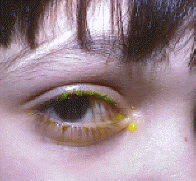 |
simple obstruction |
| congenital fistula (as seen to the left) | |
| acute dacryocystitis | |
| congenital dacryocele or mucocele |
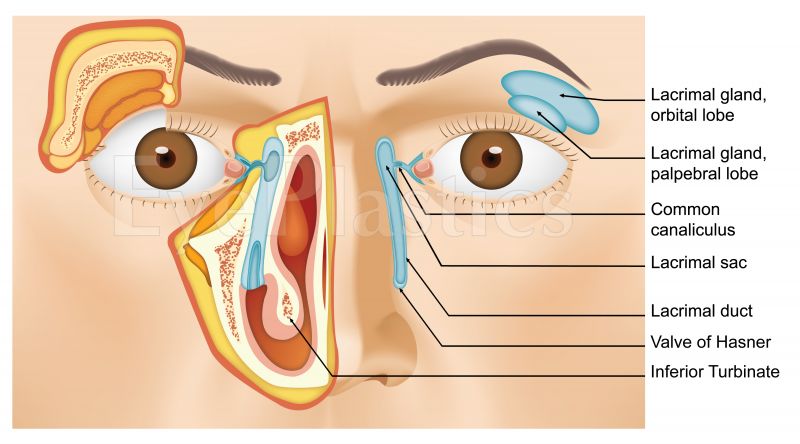
Medical Treatment of Congenital Obstructions
- Many of these do open on their own given time.
- Massaging from the tear sac in the may help create a pressure wave that can open the blockage.
Acquired (ADULT-ONSET) Nasolacrimal Duct Obstruction
-
Causes of Acquired nasolacrimal duct obstruction
- most commonly involutional
- affects females more than males
- trauma
- sinus disease
- nasal polyps
- sarcoid
- Wegener's and other granulomatous diseases
- tumor
- infection
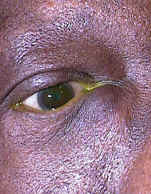
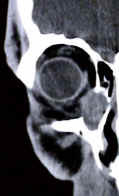
The photo and CT on the left represents a nasolacrimal duct tumor which can result in a nasolacrimal duct obstruction. Once the tumor was removed, silicone intubation performed, the patient's symptoms of tearing resolved
Click Here to learn more about the Surgical Procedures

Visit LacriCATH website.


